
Ever felt that heart-thumpin’ thrill when you see a Formula 1 car scream past the track, tires squealing like a pack of angry cats? That whirr, that blur, that impossible defiance of gravity it’s like the universe itself got a caffeine boost.
I remember once, back at the Red Bull Energy Station Las Vegas, standing barely a few meters from the track, and for a fleeting second, I thought time actually slowed. And then…
Max Verstappen blasted past, leaving nothing but a sonic shadow, and my brain went, “Whoa… they’re really this fast?” Yeah, friend, they really are. Let’s buckle up and go down this high-octane rabbit hole of speed, engineering, and pure adrenaline.
| Metric | F1 Cars | Notes / Comparisons |
|---|---|---|
| Top Speed | 210–220 mph (record 231 mph) | Modern F1 cars at full throttle on long straights |
| 0–60 mph Acceleration | 1.6–2.7 seconds | Faster than most supercars like Bugatti Chiron |
| Lap Times | 1–1.5 minutes | Depends on circuit (Monza vs Monaco) |
| Minimum Car Weight | 798 kg (2024), 768 kg (2026) | Lighter weight = faster acceleration & handling |
| Horsepower | >1,000 HP | Turbocharged 1.6L V6 hybrid engines |
| Cornering Speeds | 120–220 mph | Downforce & aerodynamics optimize grip |
| Brake to Full Stop | ~2–3 seconds from 200 mph | Uses ERS + advanced brake systems |
| Comparisons | IndyCar: ~230 mph, MotoGP: >200 mph, NASCAR: <200 mph | F1 excels in downforce & cornering |
The Lightning Facts: Top Speeds You Won’t Believe
So how fast do F1 cars actually go? Most casual folks throw around numbers like 200 mph, but let me tell ya, the reality is way more… poetic? Maybe that’s the word.
Modern F1 cars can hit top speeds of 210–220 mph, with record-breaking outliers clocking 231 mph—that’s faster than your head can really process, trust me. And yes, that’s with a human strapped in, brain screaming, G-forces hugging you like a bear on steroids.
Acceleration is even more nuts. These machines can go 0–60 mph in as little as 1.6 seconds. Compare that to a Bugatti Chiron, which might flex its muscles at 2.4 seconds.
Feels like being punched into the future by carbon fiber and turbocharged dreams. And speaking of dreams, did you know that the Williams FW36 weighed 798 kg in 2024, and engineers are pushing it down to 768 kg by 2026? Lighter means faster, and in F1, every gram counts like it’s a microsecond of eternity.
Engineering Wizardry: Why F1 Cars Fly
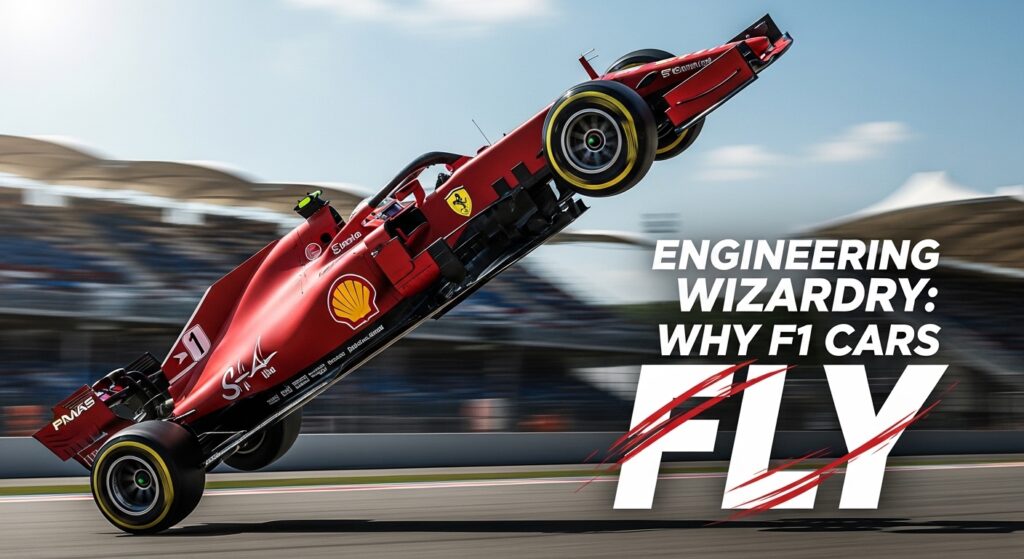
You might think it’s just raw engine power, but nah F1 cars are like ballet dancers on rocket fuel. Aerodynamics are insane; every curve, every wing, every fin on the chassis is calculated to slice the air and squeeze downforce without drowning in drag. The carbon fiber materials used? Lighter than your morning croissant but stronger than… well, pretty much anything else you could imagine.
Then there’s the engine, a turbocharged hybrid V6 1.6L beast that pumps out over 1,000 HP. Sounds like sci-fi, feels like a heart attack waiting to happen. And don’t forget the Energy Recovery System (ERS), which harvests braking energy like a magic trick from the laws of physics.
Every lap, every turn, every brake is optimized for milliseconds, because in Circuit de Monaco 2021, a tiny miscalculation can cost you the podium or a literal spin into the barriers.
Tires aren’t just rubber either. Pirelli tire compounds, soft to hard, decide grip, lap time, and sometimes destiny. Slip on a wrong compound in the Spanish Grand Prix 2023, and you’re hugging the wall faster than Fernando Alonso hugging the apex.
The Humans Behind the Machines
Of course, we can’t forget the gladiators themselves. Lewis Hamilton, Michael Schumacher, Charles Leclerc, Carlos Sainz these humans are engines with skin. They feel G-forces, sweat, heartbeat, fear, adrenaline all in the same instant they’re pressing pedals, turning wheels, negotiating apexes like it’s chess at 220 mph.
And sometimes the legends blur lines with history. Jack Brabham, for example, pioneered speeds back when F1 evolution was just flirting with 180 mph in the 1950s. Compare that to today? Yeah, lap times of 1–1.5 minutes at circuits like Monza or Circuit of Spa-Francorchamps make the past look like a Sunday drive.
Even Juan Pablo Montoya once quipped, “You’re not driving an F1 car… you’re surviving one.” There’s truth in that, especially when Valtteri Bottas dives into the braking zone like he’s trying to wrestle physics itself.
Comparing Speeds: F1 vs IndyCar vs MotoGP vs NASCAR
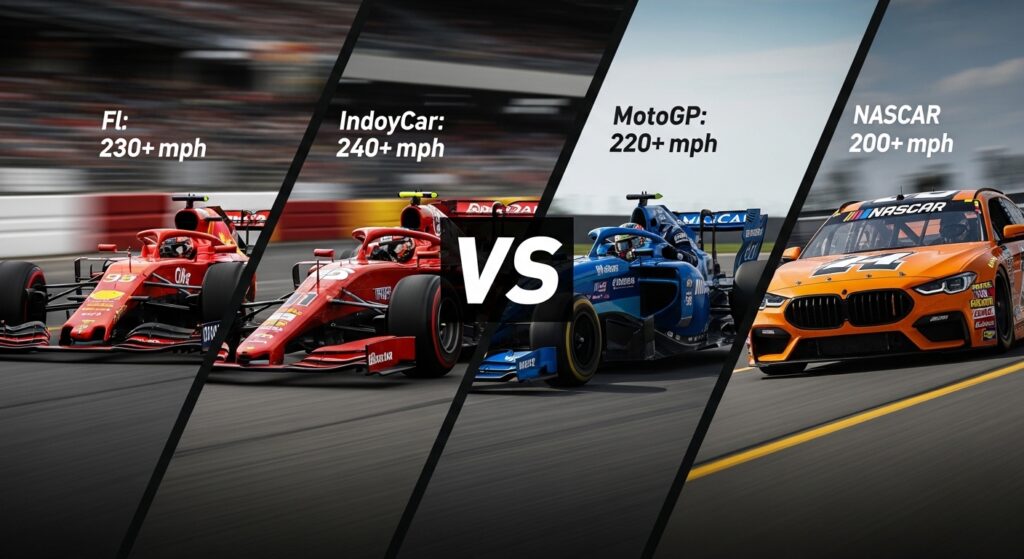
People often ask me, “Is F1 faster than IndyCar or MotoGP?” Let’s break it down without boring you:
- F1 cars: 210–231 mph top speed, crazy cornering downforce, 0–60 mph in ~2 seconds
- IndyCars: Can top 230 mph, but don’t corner like F1 they’re speed demons on straights, more like arrow missiles
- MotoGP bikes: Over 200 mph, but one leg on the asphalt, one in the wind, and a rider balancing like yoga on a rocket
- NASCAR vehicles: Less than 200 mph, but those beasts are brutal on ovals, steel and guts sliding sideways in pure spectacle
So yeah, F1 cars are basically the orchestra of speed and technology, while others are more like soloists with extreme talent.
Circuits: The Playground of Velocity
Speed means nothing without context, right? Each circuit has its own personality, kind of like the drivers themselves.
- Circuit de Monaco 2021: Tight, twisty, almost claustrophobic. You’ll never reach 200 mph here, but every corner demands surgical precision.
- Red Bull Ring (Austrian & Styrian GP): Fast, flowing, perfect for unleashing McLaren F1 Team MCL35 Renault hybrid beasts.
- Monza (Italian GP): “Temple of Speed,” where Lewis Hamilton might flirt with 220 mph and your stomach does flips.
- Circuit of America 2019: Long straights, sharp turns, and chaos that makes FIA officials sweat more than drivers.
Every track is a story, and every story has a speed record someone’s chasing.
The Human Stories: Anecdotes & Legends
History’s full of moments that make you question reality. At the Mexican Grand Prix 2016, Max Verstappen overtook like a phantom, and the crowd went mad they weren’t just watching cars, they were witnessing time bend. Or think about Michael Schumacher in Italian Grand Prix 2005, driving with a precision that makes a Swiss watch blush.
Even the technology has stories. The Red Bull-TAG Heuer RB12 TAG Heuer was a miracle of engineering, its engine humming like a beast that drank espresso and nitro. And these stories aren’t just about speed they’re about human ingenuity, about pushing the limits of physics and imagination together.
Safety: Because Fast Doesn’t Mean Reckless
People often assume that going 231 mph is pure madness and partly, yeah, it is. But modern F1 cars are safety miracles. Carbon fiber monocoques, advanced crash structures, and Pirelli tires that survive grueling laps protect drivers in ways unimaginable decades ago.
Helmets, HANS devices, FIA regulations it’s like a symphony of safety notes. You can scream “fast!” all you want, but these cars are engineered to keep drivers alive while flirting with physics.
Beyond the Track: F1 Cars in Everyday Imagination
Even if you never sit trackside, F1 cars influence dreams, toys, video games, even architecture sometimes. People watch Red Bull Racing or McLaren-Mercedes dominate, and they think, “I want to fly.” And in a way, that’s what these cars are mechanical wings. They’re art wrapped in speed, ambition, and the occasional tire smoke.
How Fast Do F1 Cars Go? The Summary You’ll Actually Remember
Let’s distill the madness:
- Top speed: 210–231 mph
- Acceleration: 0–60 mph in 1.6–2.7 seconds
- Lap times: 1–1.5 minutes, varies by circuit
- Weight: 798 kg (2024), reducing to 768 kg (2026)
- Horsepower: >1,000 HP
- Drivers: Legends like Lewis Hamilton, Max Verstappen, Charles Leclerc
- Teams: Red Bull Racing, Williams FW36, McLaren-Mercedes
- Events: Las Vegas Grand Prix, Monza, Circuit de Spa-Francorchamps
These numbers don’t just measure speed they measure human ambition, engineering dreams, and the beautiful chaos of motorsport. Every tick of the clock on a lap timer is a story of risk, courage, and pure science.
Practical Tips: Experiencing F1 Speed Yourself
You don’t need to be strapped into a McLaren F1 Team MCL35 Renault to feel the thrill. Here’s how:
- Sim racing: Modern sims mimic downforce, braking energy recovery, even tire wear. You’ll understand why Carlos Sainz smiles on track.
- Track days: Some circuits let civilians drive high-performance cars. Not F1, but close enough to feel IndyCar vibes.
- Live events: Stand near a straight at Red Bull Energy Station Las Vegas or Circuit de Barcelona-Catalunya. Trust me, your heart will do math F1 engineers envy.
- Tech deep dives: Learn about ERS, aerodynamics, and hybrid engines. It’s nerdy, but thrilling like reading a thriller where every sentence is horsepower.
Read this Blog: https://nexovates.com/long-is-25-feet/
Frequently Asked Questions
how fast do f1 cars go
F1 cars typically reach top speeds between 210 and 220 mph, with the fastest recorded speed at 231 mph. Their speed comes from advanced aerodynamics, hybrid engines, and specialized tires.
how fast do f1 drivers go
F1 drivers can accelerate from 0 to 60 mph in around 1.6 to 2.7 seconds, maintaining extremely high speeds while cornering thanks to downforce and precise car control.
how fast does a formula 1 car go
A Formula 1 car can hit over 230 mph in ideal conditions, with lap speeds varying depending on the track layout and technical sections.
how fast can f1 cars go
Modern F1 cars can reach a maximum of 231 mph, with acceleration and handling allowing them to sustain high speeds through corners.
how fast are f1 cars
F1 cars are among the fastest racing vehicles in the world, averaging 210–220 mph on straights and excelling in rapid acceleration and cornering.
Conclusion: The Beauty of Velocity
Speed isn’t just numbers. It’s courage, precision, and a little bit of madness. F1 cars embody what humans can achieve when obsession meets creativity. From Jack Brabham in the 1950s to Max Verstappen today, every driver, every engineer, every Pirelli tire whispers a story: “Push limits, respect physics, and never stop dreaming.”
Next time you see a blur on a track, think of it as more than a car it’s history, science, and art all tangled in carbon fiber, gasoline, and human spirit. That, my friend, is how fast F1 cars really go.

