
There’s something oddly slippery about numbers like 500 feet visualization. You hear it, nod your head like “yeah okay that’s big,” and then your brain quietly forgets what it even means five seconds later. Happens to most of us, no shame in it really. But when you actually try to feel 500 feet, it turns into this strange mental puzzle where everyday reality kinda bends a little.
I remember once standing in an open field trying to imagine the length, and I thought, “okay maybe like two buses?” which was hilariously wrong. Because distance scaling at human level perception is just… unreliable. Our brains are better at faces than lengths, honestly.
So in this piece, we’re gonna stretch imagination, twist it a bit, and walk through real-world giants that sit around the 500 feet comparison mark. Some are man-made monsters, others are sports spaces, and a few are things you might not even expect. And yeah, I’ll probably misjudge a few things along the way too, just like anyone else.
| Thing | Approx Size | Relation to 500 Feet |
|---|---|---|
| Soccer field (professional football pitch) | ~300–360 ft | ~1.5 fields ≈ 500 ft |
| American football field | 360 ft | Slightly shorter than 500 ft |
| Olympic swimming pool | 164 ft | ~3 pools end-to-end ≈ 500 ft |
| Boeing 747 Jumbo Jet | ~230–250 ft | ~2 jets ≈ 500 ft |
| Cruise ship (large modern liner) | 1,000+ ft | Half ship ≈ 500 ft |
| Nimitz-class aircraft carrier | ~1,092 ft | ~half length ≈ 500 ft |
| Empire State Building | 1,454 ft (height) | ~1/3 height ≈ 500 ft |
| City block (urban average) | 300–600 ft | Close to ~500 ft range |
| Baseball field foul line | ~300–400 ft | Slightly under 500 ft |
| Shinkansen/TGV train set (multiple cars) | ~400–700 ft | Around ~500 ft total length |
500 Feet in Transportation Giants That Feel Almost Unreal

If you want to feel 500 feet in your bones, start with machines that dominate air and sea. These are not small toys, they’re basically moving cities.
The Boeing 747 Jumbo Jet (or just Boeing 747) is often used as a mental anchor for aircraft size. At roughly 230–250 feet in length depending on variant, you’d need about two of them nose-to-tail to even approach 500 feet. And when you stand near one at an airport, it already feels like a flying building. So doubling that? Yeah, it gets weird fast.
Now imagine something even larger floating on water: the Cruise ship Wonder of the Seas. This floating giant pushes past 1,000 feet, so half of it already lives comfortably in the 500 feet length objects category. It’s like a moving city block, with pools, theaters, and corridors that feel like they never end. Someone once said, “you don’t walk on a cruise ship, you migrate,” and honestly that quote stuck.
Then there’s the legendary Nimitz-class aircraft carrier, a true sea beast. At around 1,000 feet full length, 500 feet is basically just the front half where jets sit like sleeping birds waiting for chaos. Standing on one would mess with your spatial perception of length because everything is flat, wide, and deceptive.
And weirdly enough, even high-speed travel helps us understand scale. The Shinkansen and TGV systems slice through space so fast that you stop noticing length entirely and start thinking in time instead. A 500 feet train segment doesn’t feel long when you’re inside it, it just disappears under speed.
500 Feet Comparison Using Sports Fields and Human Movement
Sports fields are like the easiest cheat code for understanding big distances because we’ve all seen them on TV or in school grounds.
A standard soccer field (professional football pitch) is about 300–360 feet long. So 500 feet? That’s like one full field plus a chunky extra piece at the end where players are just confused why the whistle didn’t blow yet.
An American football field (including end zones) is about 360 feet. Again, 500 feet stretches beyond it like someone forgot to stop building the stadium.
Now the baseball diamond foul lines are interesting because they shoot out diagonally and feel longer when you’re watching a home run attempt. But even then, 500 feet outruns most stadium dimensions by a noticeable margin.
And then there’s the Olympic swimming pool, which is 164 feet long. Stack three of them end-to-end and you’re close-ish to 500 feet. Imagine swimming that distance in open water by lap three you’d probably start questioning life choices a bit.
To make it even more human, think of Usain Bolt, the fastest man many of us have ever watched. In his prime sprint, he could cover a little over 100 meters (about 328 feet) at top speed. So 500 feet is like Bolt sprinting almost twice his maximum televised glory run. That comparison alone hits differently.
500 Feet in Architecture and Sky-High Urban Imagination

Cities are probably the best place to mentally map 500 feet because everything stacks vertically and horizontally in chaotic harmony.
Take the Empire State Building. Its height is way above 1,000 feet, so 500 feet sits roughly around its midsection—like halfway up a structure that already makes you dizzy from the street. When you look up at it from below, your brain already starts doing weird comparative measurement reasoning tricks, like “that window looks small, but is it tho?”
Skyscrapers in general are a great lesson in urban structure dimensions. At 500 feet, you’re talking about buildings that dominate skylines in most cities, casting long shadows that shift the entire mood of a neighborhood.
Urban planners often think in terms of sunlight and zoning, where 500 feet of height or length can influence shadow paths and airflow. It’s not just size, it’s how the environment reacts. A small shift in measurement can change how people live below it, kinda wild when you think deeply.
Even walking 500 feet in a dense city block can feel longer than it is because of noise, distractions, and crowd density. That’s where city block (urban measurement reference) comes in because blocks vary so much that your brain never fully trusts them.
500 Feet in Engineering, Infrastructure, and Big Human Ideas
When engineers design large infrastructure, they don’t think “wow that’s long,” they think “how do we keep this stable.”
A high-speed rail systems (general) track segment of 500 feet is basically nothing in railway terms, yet it still requires precise alignment. Tracks like Shinkansen and TGV train system lines are built with extreme accuracy, where even tiny miscalculations ripple across kilometers.
In aviation infrastructure, aircraft dimensions and wingspan design also plays a role in understanding space. A Boeing 747 might sit within a few hundred feet, but airport runways and taxiways stretch far beyond 500 feet just to handle motion safely.
Even maritime engineering treats 500 feet as a manageable slice of something much bigger. Modern cruise ships (floating cities concept) are so massive that 500 feet becomes just a neighborhood section with restaurants and pools.
Infrastructure planners often rely on distance estimation techniques and real-life measurement comparisons to make sense of scale, because raw numbers don’t mean much without context.
Natural and Everyday Ways to Feel 500 Feet Around You

Nature doesn’t label things in feet, but we still try to map it anyway. A long stretch of beach or riverbank can easily hit 500 feet without you realizing it.
A half-mile distance is about 2,640 feet, so 500 feet is roughly one-fifth of that. Still enough to feel like a proper walk where you might start checking your phone halfway through.
In everyday life, a long parking lot might reach close to this range, especially in markets or large campuses. It’s also about 100–150 average car length approximation units stacked together, which sounds ridiculous but kinda helps visualize it.
Walking 500 feet usually takes a couple of minutes depending on pace. That’s part of walking distance estimation, where your brain guesses time better than actual length. Humans are funny like that.
Cognitive Tricks to Actually Understand 500 Feet
Our brains are not naturally good at large-scale measurement. That’s why mental mapping of large distances becomes important.
One trick is analogical thinking: replace 500 feet with things you already understand, like sports fields or buildings. This is called analogical reasoning (object-to-distance mapping) in simple terms.
Another trick is breaking it down. Instead of seeing 500 feet as one chunk, imagine five segments of 100 feet. Suddenly it becomes less scary, more manageable.
We also rely heavily on intuitive scaling using familiar objects, like buses, cars, or buildings. It’s not perfect, but it works well enough for human brains that still think like hunters sometimes.
Strange Real-Life Moments Where 500 Feet Feels Different
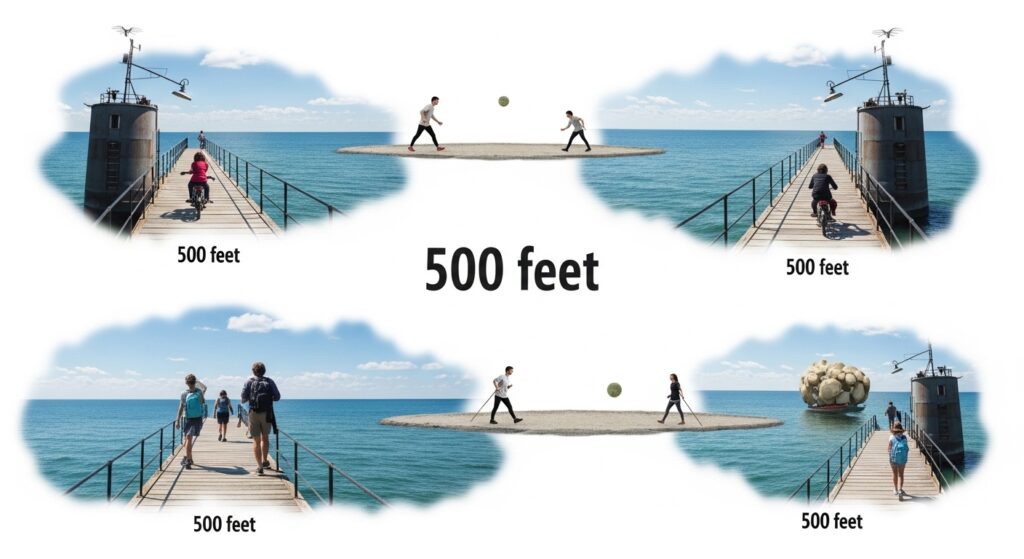
Funny thing about distance is how context changes everything. At an airport, 500 feet feels short because everything is massive. In a quiet street, it feels like forever.
I once heard someone say, “500 feet in a storm feels like a marathon,” and that stuck with me. Weather messes with perception more than we admit.
Even athletes perceive it differently. A sprinter sees it as seconds of effort, while a tired walker sees it as a small journey.
There’s also psychological distortion when you’re waiting for something, 500 feet can feel longer. When you’re distracted, it disappears quickly.
Final Thoughts: Why 500 Feet Is Bigger in Your Mind Than on Paper
At the end of the day, 500 feet isn’t just a measurement, it’s a shifting idea. It changes depending on whether you’re thinking about a Empire State Building shadow, a roaring Cruise ship Wonder of the Seas, or a quiet walk across a soccer field (professional football pitch).
It sits somewhere between human comfort and architectural ambition, between what we can walk and what we can build. And honestly, it’s a nice reminder that numbers are just starting points, not the full story.
When we connect real world object comparison with imagination, 500 feet stops being abstract and becomes something we can almost touch mentally. Not perfectly, maybe a bit blurry, but real enough.
And if there’s one takeaway, it’s this: next time someone says “it’s about 500 feet away,” don’t shrug it off. Picture jets, ships, stadiums, and city blocks all stitched together in your mind. It makes the world feel a bit more measurable, and a bit more strange in a good way.
If you’ve ever had your own weird way of imagining distances like this, or misjudged something hilariously, I’d actually love to hear it.

