
There’s something oddly tender about a sequence of numbers. I know, that sounds dramatic for digits sitting in a row like laundry waiting to be folded, but stay with me. The first time I saw the Number sequence 7, 10, 16, 28, 52, I didn’t just see arithmetic I saw a story trying to breathe. And maybe that’s what all good puzzles are: quiet little stories pretending to be problems.
If you’ve ever stared at a list of numbers and felt that tiny spark in your chest the one that says, “I almost see it, I just need one more second” then you already understand the beauty of Pattern recognition. It’s not just math. It’s anticipation. It’s trust. It’s the hope that things, even strange things, follow an Underlying rule.
So let’s sit with this sequence. Let’s unfold it slowly. Because the answer spoiler alert is 100. But the journey to the Next number in sequence is where the real gold is hiding.
| Term (n) | Value | Difference from Previous Term | Notes on Pattern |
|---|---|---|---|
| 1 | 7 | – | Starting value |
| 2 | 10 | 3 | 3 × 2 → next diff |
| 3 | 16 | 6 | 6 × 2 → next diff |
| 4 | 28 | 12 | 12 × 2 → next diff |
| 5 | 52 | 24 | 24 × 2 → next diff |
| 6 | 100 | 48 | Next number in sequence |
The Quiet Drama of a Mathematical Sequence
The numbers 7, 10, 16, 28, 52 don’t look friendly at first glance. They’re not behaving like a simple Arithmetic sequence where you just add 3 each time and call it a day. No, this is a slightly rebellious Mathematical sequence, the kind that makes you lean in and whisper, “What are you hiding?”
Let’s look at the differences between the Consecutive terms:
10 − 7 = 3
16 − 10 = 6
28 − 16 = 12
52 − 28 = 24
Now pause.
3, 6, 12, 24.
That’s not random. That’s doubling.
This is what we call a Difference pattern, and more specifically, it reveals something deeper when we examine the Sequence of differences. Each difference is twice the previous one. That’s a Predictable increase, and predictable increases are like footprints in snow clear, undeniable, slightly magical.
So if the differences go 3, 6, 12, 24… what comes next?
24 × 2 = 48.
Now we return to our last term:
52 + 48 = 100.
And there it is. The answer to the puzzle. The quiet, confident 100.
That’s Sequence progression in action. That’s Predicting the next value using careful Mathematical reasoning instead of guesswork. It’s not flashy. It’s just beautifully logical.
What Is the Next Number in This Sequence 7, 10, 16, 28, 52 And Why Does It Matter?
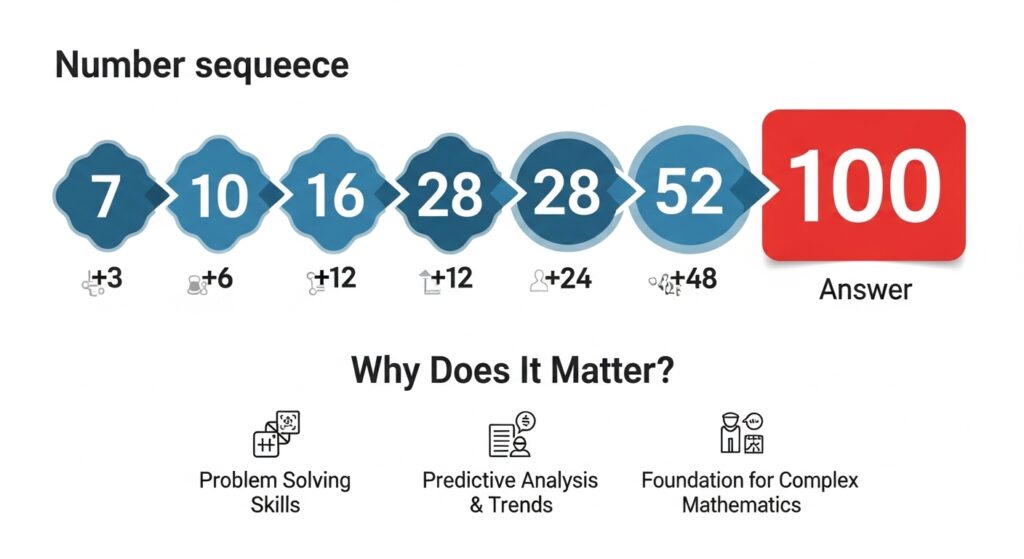
You might be thinking, “Okay sure, it’s 100. Cute. But why should I care?”
Because this is more than just Solving number series. This is about training your brain to notice patterns in chaos. It’s about sharpening your Problem-solving skills so that when life throws you 7, 10, 16, 28, 52 you don’t panic. You observe.
The method we used is often called the Difference method. When the first level differences show a pattern, you’re already winning. Sometimes you even have to go deeper into Second-level differences, but here the doubling pattern revealed itself early, like it wanted to be found.
That’s the beauty of Mathematical logic. It rewards patience.
Educators like Franz Jerby Delos Santos often explain that number puzzles are not about speed but about Pattern identification. He once described sequences as “conversations between numbers,” which sounds poetic for a math classroom, but honestly? He’s not wrong.
The Recursive Whisper Behind the Numbers
Let’s talk about something slightly more elegant the idea of a Recursive formula.
In this case, each term depends on the Previous term plus a doubling increment. That creates what we can describe as a Recursive sequence, where each step builds off what came before.
You could express it like this:
Start with 7.
Add 3.
Then double the increment each time.
This forms a Recursive expression that captures the structure of the entire sequence.
And if that feels like stepping into Advanced math concepts, don’t worry. It’s really just controlled growth. An Increment pattern. A rhythm.
When you understand this rhythm, you’re not just memorizing answers. You’re mastering Algebraic thinking without even realizing it.
Difference Patterns and the Art of Mathematical Operations
Now let’s zoom out.
What did we actually use here?
We used Mathematical operations. Specifically:
• Addition to move from one term to the next
• Multiplication to double the increments
• A touch of conceptual Division to confirm patterns if needed
This blend of operations is what makes number puzzles rich. They’re rarely about one single action. They’re about interaction between actions.
Think of it like cooking. You don’t just add salt. You layer flavors. In sequences, you layer operations.
Some puzzles are more twisted. Consider the sequence:
9, 3, 1, 1, 3
Or even stranger:
2, 3, e, 4, 5, i, 6, 8
These aren’t just numeric they blend symbols, logic, sometimes letters. They challenge your Numerical reasoning in unexpected ways.
And then there are beasts like:
100, 96, 104, 88, 120, 56
Those demand deeper Series analysis, maybe even exploring alternating patterns. Every sequence is a personality test for your brain.
What Is the Next Number in This Sequence 7, 10, 16, 28, 52 A Step-by-Step Solution
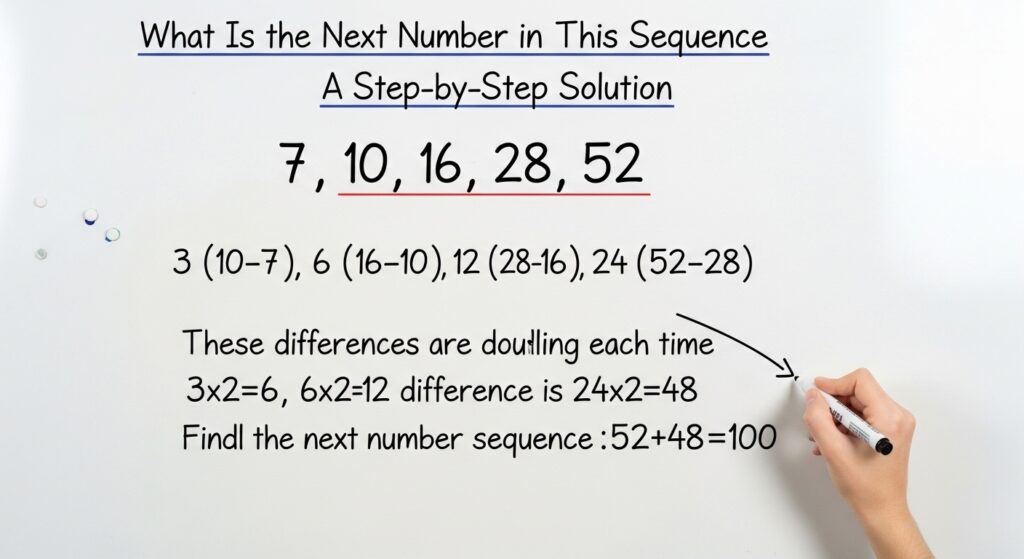
Let’s slow it down and walk through it again as if we’re in a classroom together.
• Identify the Consecutive terms
• Subtract to find the Sequence of differences
• Observe the doubling pattern
• Continue the pattern
• Add the new difference to the last term
This is classic Sequence problem explanation territory.
Some educators, including Phoebe Belza-Barrientos, emphasize that students should always ask, “What changes between the numbers?” That question alone unlocks half of all sequence puzzles.
The difference grows like this:
3 → 6 → 12 → 24 → 48
So 52 + 48 = 100.
It’s almost satisfying in a physical way, isn’t it?
That’s the power of Finding the next term through structured thinking instead of guessing.
Why Pattern Recognition in Math Feels So Personal
There’s something deeply human about searching for patterns. We do it in faces. In music. In behavior. In the way seasons change.
Pattern recognition in math is just a formalized version of something we already do instinctively.
When a student finally sees the pattern, their eyes light up in a way that’s hard to describe. As Rachelle Bencio Yu once shared in a workshop, “The moment a learner understands a sequence rule, they stop fearing numbers.”
That’s huge.
Because fear is often the biggest obstacle in Numerical problem solving.
And organizations like Brighterly have built entire learning frameworks around interactive Math challenges and Sequence exercises that encourage exploration instead of memorization.
It’s not about drilling answers. It’s about cultivating intuition.
Mathematical Patterns and Incremental Growth
If we zoom out even further, this sequence is an example of an Incremental growth pattern. The growth isn’t constant—it accelerates.
That’s important.
Constant growth would look like 7, 10, 13, 16, 19… and so on. But here, the increments themselves grow.
This is where Second differences sometimes come into play. In our example, the second-level differences are also doubling, which signals exponential-like behavior in the increment itself.
That might sound intimidating, but it’s just structured change.
Educator Janice S. Armas notes that exposing students early to non-linear sequences strengthens Mathematical reasoning. It builds flexibility. It prevents rigid thinking.
And rigidity is the enemy of insight.
Solving Number Series as a Life Skill (Yes, Really)
I know it might sound dramatic to say that learning how to decode a Mathematical sequence can change your life, but hear me out.
When you practice Logical analysis, you train your brain to pause before reacting. To examine. To test assumptions.
That’s not just math. That’s decision-making.
Even Laila A. Lico has spoken about how structured puzzles enhance cognitive resilience. When children engage in Practice number sequences, they build mental endurance.
And endurance is what carries you through complexity.
Read this Blog: https://nexovates.com/what-is-175-degrees-celsius-in-fahrenheit/
Frequently Asked Questions
What is the next number in the sequence? 7….10….16….28…
The sequence appears to follow a pattern where each number is the previous number plus an increasing difference (3, 6, 12, …). The next number is 52.
7 10 16 28
Looking at the differences between terms (3, 6, 12), the next number continues this pattern: 52.
What is the next number in the sequence 7 10 16
Using the same difference pattern (3, 6), the next number in the sequence is 28.
What is the next number in the sequence 710 1628
This seems to be a typo; separating numbers as 7, 10, 16, 28, the next number would be 52.
The Final Answer, and the Bigger Lesson
So yes.
The Next number in sequence 7, 10, 16, 28, 52 is 100.
But more importantly, the method to reach 100 is what matters.
We observed the Difference pattern.
We identified the doubling increments.
We applied Addition and Multiplication.
We trusted the logic.
That’s the heart of Sequence rules.
The answer didn’t appear by magic. It appeared through careful, deliberate thinking. A kind of thinking that grows stronger every time you engage with puzzles like this.
And maybe that’s the quiet gift of sequences. They teach us that patterns exist—even when they’re not obvious at first glance. They teach us patience. They teach us to look twice.
So the next time you encounter a string of numbers that feels confusing or slightly stubborn, don’t rush past it. Sit with it. Listen to it. Ask it what it’s trying to become.
Because somewhere between 7 and 100, there’s a lesson about growth hiding in plain sight.
And honestly? That’s kinda beautiful.

