
There’s something kind of magical about pulling a card from a fresh pack, the crinkle of the foil, the glint of colors catching your eye… it’s a tiny little thrill that sticks with you, even if you’re 30 or 10. I still remember the first time I held a Pokémon card in my hands.
The texture, the faint bend that felt just right, the way the Pokémon Trading Card Game (TCG) universe suddenly seemed infinite in the palm of my hand it was like holding a universe made of cardstock.
And y’know, if you’ve ever wondered why collectors get so obsessed, the first step is understanding the humble little dimensions of these cards. Yup, the numbers, the thickness, the corners… it’s more than nerdy math it’s the foundation of every trade, battle, and collectible obsession.
| Feature / Item | Measurement / Weight | Notes |
|---|---|---|
| Standard Pokémon Card Dimensions | 2.5 × 3.5 in (63.5 × 88.9 mm) | Base size for all regular cards |
| Aspect Ratio | 5:7 | Ensures uniform look & shuffling ease |
| Card Thickness | 0.012 in (0.305 mm) | Sturdy yet flexible for gameplay |
| Corner Radius | ~0.125 in (~3.18 mm) | Prevents wear & tear |
| Weight of Card | 1.78 g | Approx. same as a paperclip |
| Sleeve Size Needed | 2.64 × 3.58 in (67 × 91 mm) | Slightly larger to avoid edge wear |
| Booster Pack Weight | 22–25 g | Contains 10 cards on average |
| Elite Trainer Box (ETB) Weight | 280–300 g | Includes multiple packs, sleeves, and tokens |
| Theme / Battle Deck Weight | 190–210 g | Ready-to-play decks |
| Special Collection Box Weight | 500–800 g | Premium packs with collectibles |
Standard Pokémon Card Dimensions: Why Size Actually Matters
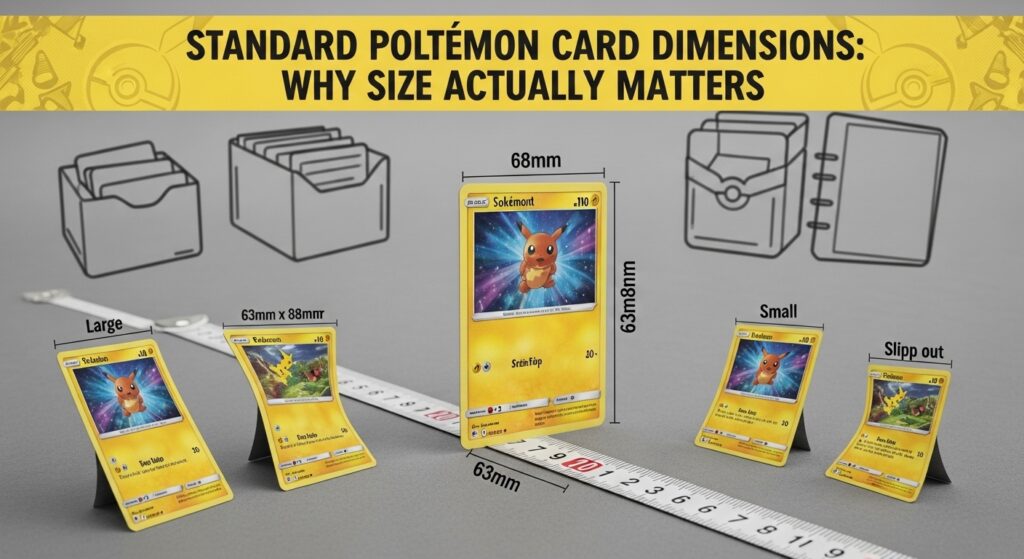
Most people think a Pokémon card is just a rectangle with a creature on it, but there’s real precision here. The Standard Pokémon Card Dimensions are 2.5 in × 3.5 in (63.5 × 88.9 mm).
That’s… not tiny, not huge, but perfect for shuffling, stacking, and sliding into your binder like a secret treasure. Fun fact: the aspect ratio is exactly 5:7, which makes it visually satisfying when lined up next to other cards.
And the corner radius is about 0.125 in (~3.18 mm), which isn’t just a random number those rounded edges prevent the corners from curling up or wearing down too quickly when you’re riffling through decks at a tournament.
Card thickness is another sneaky detail: 0.012 in (0.305 mm). That’s roughly a third of a millimeter, which makes the card sturdy but flexible enough to shuffle without snapping. And yes, the average weight of a Pokémon card is around 1.78 g.
If you like analogies, that’s about the weight of a paperclip. So next time you’re holding a Charizard card (Base Set), you’re cradling something tiny but meticulously measured, designed for both durability and collectibility.
Pokémon Card Types: More Than Just Monsters
If you think all Pokémon cards are just creatures with stats, lemme tell ya you’re only seeing half the picture. The Pokémon Trading Card Game (TCG) universe is surprisingly layered, like a sandwich you didn’t know had pickles inside. Cards break down into several categories:
- Basic Pokémon The foundation of your deck, like Bulbasaur or Squirtle.
- Evolution Pokémon When your starter hits puberty and becomes stronger (yes, Charizard is basically a teen now).
- Trainer Cards Items, supporters, stadiums they’re the strategy backbone.
- Item Cards Healing potions, Poké Balls, or things that just make your day slightly better.
- Supporter Cards Big effects but one per turn; it’s like having a cheat code legally.
- Stadium Cards The environment matters, folks. Grasslands, volcanoes, beaches… it’s all tactical.
- Energy Cards The fuel for attacks, because even Pokémon get hangry.
- Special Energy Cards Fancy, rare, sometimes holographic, and very Instagram-worthy.
These categories don’t just matter for play they also impact how you protect, store, and value your cards.
Protective Gear: Sleeves, Toploaders, and More
If the Standard Pokémon Card Dimensions are sacred, the right protective gear is holy. Whether you’re showing off a newly pulled holo Charizard card (Base Set) or carefully managing a full Elite Trainer Box (ETB), sleeves and storage are non-negotiable.
- Penny Sleeves Premium Sleeves The entry-level armor for your cards. Keep ‘em snug, cheap, and flexible.
- Toploaders Rigid plastic sheaths for cards that are “too precious for normal life.”
- Binder Pockets For collectors who wanna flip through cards like they’re vintage stamps.
Here’s a pro tip: your sleeve size needed is slightly bigger than the card itself, at 2.64 × 3.58 in (67 × 91 mm). That extra wiggle room prevents edge wear when shuffling, and trust me, every edge matters when you’re chasing a mint-condition rare card.
Comparing Pokémon Cards to Other Trading Cards
The world of trading cards doesn’t end with Pokémon. There are competitors like Magic: The Gathering, Yu-Gi-Oh!, and even niche ones like KeyForge, each with their own quirks.
- Magic: The Gathering Slightly narrower, often heavier cardstock, more abstract fantasy artwork.
- Yu-Gi-Oh! Smaller cards, fast-paced gameplay, mostly in anime-themed duels.
- KeyForge Unique deck game; no two decks are alike, changing the math entirely.
Even in terms of weight, Pokémon cards are feather-light: a booster pack weighs 22–25 g, whereas an Elite Trainer Box (ETB) sits around 280–300 g—a serious upgrade in heft and collection potential.
Environmental Factors: Cards Aren’t Invincible
One thing people underestimate is how environmental factors affect your collection. Pokémon cards are deceptively delicate:
- UV rays fade holographic foils faster than a toddler loses interest in broccoli.
- Heat can warp cardstock, especially if left in cars or near heaters.
- Moisture? Forget it. A wet card is basically ruined.
Pro collectors swear by cool, dry storage, using polypropylene sleeves or even hard plastic containers to preserve the luster. Dust, scratches, and humidity can kill the card’s value faster than a misplayed Energy card in battle.
Pokémon Card Dimensions Consistency Across Editions
Something that rarely gets talked about outside hardcore communities is how consistent Pokémon card dimensions are internationally. From the original Base Set to modern expansions, the aspect ratio of 5:7 is maintained religiously. Why? Because tournaments, collectors, and deck-building apps depend on uniformity.
Even promotional or oversized cards follow scaled versions of the same ratios. It’s like a secret language of dimensions one that helps keep your binder looking pristine and your trades fair.
Valuing Your Cards: More Than Looks
Understanding dimensions and protection isn’t just about survival it’s about investment. A Charizard card (Base Set) in perfect condition can fetch thousands of dollars because collectors recognize not just the image, but the care, storage, and preservation. A slight bend or worn corner, and suddenly it’s worth a fraction of what a mint one costs.
Counterfeit detection also relies on dimensions. Weight, thickness, and even corner radius are surprisingly telling. Some scammers overlook tiny details like the 0.305 mm thickness, but a trained eye notices instantly.
Read this blog: https://nexovates.com/pokemon-card-dimensions/
Fun Mini-Stories from the Pokémon Community

I remember a local tournament where a kid accidentally bent a rare holo Pikachu while celebrating a win. Everyone gasped, but instead of rage, the community laughed and helped him sleeve every card in his deck. Tournaments aren’t just about winning they’re about sharing stories, learning card handling, and celebrating the obsession with these tiny rectangles of joy.
Another collector once told me, “Every card has a soul. You don’t just hold it you respect it.” And honestly, when you think about the meticulous measurements, the careful printing, and the endless variety of Pokémon types Water, Fire, Grass, Electric, Psychic that’s kind of true.
Making Your Collection Personal
So, how do you make your Pokémon cards more than a stack in a binder? A few ideas:
- Label binders by Pokémon types, or by rarity tiers, so each page tells a story.
- Keep a mini-diary of when you pulled each rare cardsometimes memories are worth more than money.
- Mix in other collectible games like Magic: The Gathering or Yu-Gi-Oh! to see differences in dimensions and feel.
- Rotate display cards weekly, keeping the holographic magic alive and preventing sun fading.
Even something as simple as choosing between penny sleeves and toploaders can reflect your personality as a collector.
Frequently Asked Questions
What are the standard Pokémon card dimensions?
The standard Pokémon card dimensions are 2.5 × 3.5 in (63.5 × 88.9 mm) with an aspect ratio of 5:7.
How thick is a Pokémon card?
Each card has a thickness of 0.012 in (0.305 mm), making it sturdy yet flexible for shuffling.
What sleeve size do I need for protection?
Use sleeves sized 2.64 × 3.58 in (67 × 91 mm) to prevent edge wear and keep cards safe.
How much does a Pokémon card weigh?
A standard card weighs about 1.78 g, roughly the same as a paperclip.
Can environmental factors damage cards?
Yes heat, UV light, and moisture can warp, fade, or damage your cards, so store them in a cool, dry place.
What types of Pokémon cards exist?
There are Basic Pokémon, Evolution Pokémon, Trainer cards, Item cards, Supporter cards, Stadium cards, Energy, and Special Energy cards.
Conclusion: The Tiny Rectangles That Hold Big Worlds
At the end of the day, Pokémon cards are deceptively small, but their universe is massive. Each card, perfectly measured at 2.5 in × 3.5 in, weighs just under 2 grams, yet carries endless strategy, art, and nostalgia.
From Basic Pokémon to Special Energy cards, from booster packs to Elite Trainer Boxes, the tiny details dimensions, thickness, corners shape every battle, every trade, and every collector’s joy.
Whether you’re a casual player, a tournament fighter, or a hardcore collector, knowing these dimensions isn’t just nerdy trivia it’s the secret handshake of the Pokémon world. So sleeve them, store them, respect the card durability, and maybe, just maybe, one day you’ll hold a Charizard card (Base Set) that feels like holding a piece of magic in your hands.
And remember: Pokémon cards aren’t just cards they’re memories, stories, and tiny rectangles of wonder waiting for you to explore.

