
Sometimes i find myself staring at a plastic jug of water, thinking “how heavy is this really?” It’s funny, isn’t it? We pour it, drink it, fill bathtubs with it, yet rarely do we pause to feel its mass in our hands and minds.
Imagine hauling 5 of those jugs around suddenly, it’s not just a kitchen chore, it’s physics and chemistry dancing together in your palms. 5 gallons of water seems like an ordinary everyday object, but when you start exploring weight of water, volume, density, and the interplay of temperature effect on density, a simple jug becomes a portal into the mysteries of hydrogen and oxygen bonding.
Water is not just life. It is a story of molecules packed just so, moving, expanding, contracting, shaping the state of matter around us. Today, let’s untangle this story by looking at the humble 5 gallons of water, discovering its weight in pounds, its liters equivalent, and why room temperature water might surprise you with its subtle quirks.
| Measurement | Value |
|---|---|
| Volume (US gallons) | 5 gallons |
| Volume (liters) | 18.925 liters |
| Weight (kilograms) | 18.9 kg |
| Weight (pounds) | 41.7 lbs |
| Water density | 1 kg/L (8.34 lbs/gallon) |
| Temperature | Room temperature (~25°C / 77°F) |
The Basics: What is the Weight of 5 Gallons of Water?
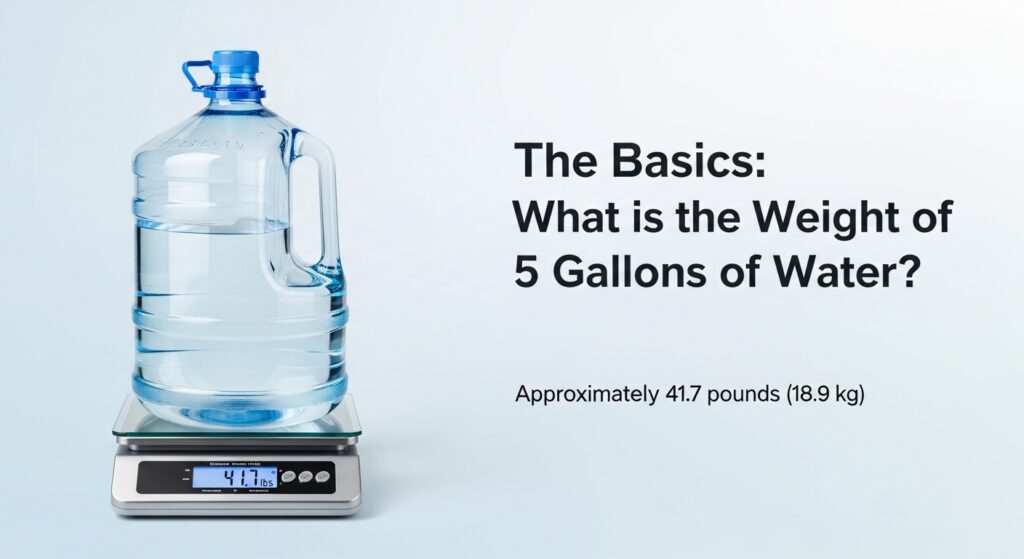
Alrighty, let’s get down to numbers without being boring. A single US gallon holds roughly 3.785 liters. Multiply that by five, and you’re at 18.925 liters. Now, here’s where water density at room temperature enters the scene.
Each liter of liquid water weighs about 1 kilogram per liter so our 5 gallons clock in at almost 18.9 kilograms. But if you’re thinking in pounds, the conversion is also neat: 41.7 pounds (weight of 5 gallons). Yep, that’s right, what looks deceptively light in a translucent jug is actually quite a heft.
And if you’re the type who loves formulas, remember this: Density × volume formula gives us a neat weight calculation formula. That is, weight = water density × volume.
For our 5 gallons of water, that’s 8.34 pounds per gallon × 5 gallons = boom, 41.7 pounds. Carrying this around a garden or to a camping site? You’ll suddenly respect the physics behind hydration.
Water Density: Why It’s Not Just a Number
Ever noticed ice floating on your soda or a chunk of ice in a pond? That’s because ice vs liquid water density difference makes frozen water less dense. Liquid water molecules are packed closer, while ice expands due to the molecular structure of water, a quirky dance of hydrogen and oxygen bonds. This is why a jug of room temperature water weighs a smidge more than frozen water.
Temperature effect on density isn’t huge for everyday use but becomes crucial in scientific setups. Chemists and lab technicians, for example, need precise liquid measurement conversion. A liter of water at 0°C will slightly differ in mass per unit volume than the same liter at 25°C due to thermal expansion. Mind blown, right?
Even small changes matter if you’re filling irrigation systems, swimming pools, or calculating water load for construction projects. Imagine miscalculating and the tankers bring a few hundred extra pounds suddenly your truck’s vehicle weight limits become a real worry.
Converting Units: Gallons, Liters, Pounds, Kilograms
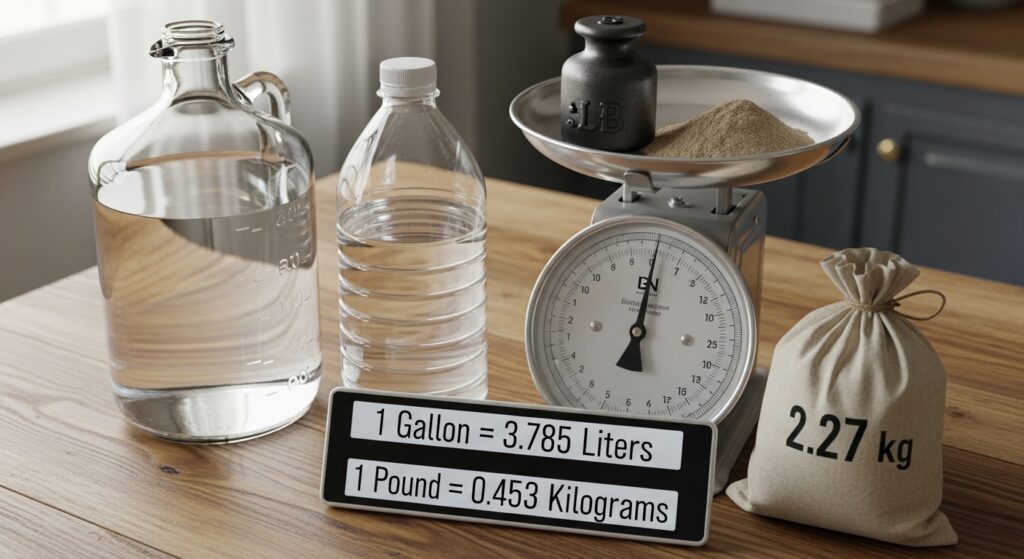
Ah, the eternal battle: Imperial system vs Metric system. Americans often think in gallons and pounds, while most of the world talks in liters and kilograms. For 5 gallons of water, you already know it’s 18.925 liters, weighing 41.7 pounds or 18.9 kilograms.
For those who like quick mental tricks:
- Gallon to liter conversion: multiply by 3.785
- Liters to kilograms conversion: 1-to-1 for water at room temp
- Pounds to kilograms conversion: divide by 2.2046
Keep this cheat sheet in your mind next time you’re transporting bulk water or measuring exact volumes for a marathon hydration plan. It saves backaches and spilt water.
Practical Implications: Carrying, Filling, and Using 5 Gallons
So now you know the science, but how does it matter day-to-day? Picture this: you’re carrying water to your garden. One 5-gallon jug is fine, but three? That’s 125 pounds if you’re in pounds world. That’s why portability considerations matter. Plastic jugs, sturdy handles, or splitting the load is not just smart—it’s physics.
In farming or agricultural irrigation, knowing the weight of water for irrigation is crucial. Pumps, pipes, and water tanks have limits. Overflow? Risky. Underfill? Crop stress.
Similar logic applies in construction projects where water is used for blending compounds or hydrating cement. A miscalculated bulk water weight can throw off the balance, literally.
Even leisure activities, like filling a swimming pool or camping water cans, benefit from knowing these numbers. Knowing weight of water in pounds or kilograms helps you avoid accidents and makes planning hydration smoother for triathlon hydration or marathon hydration.
The Chemistry Behind 5 Gallons
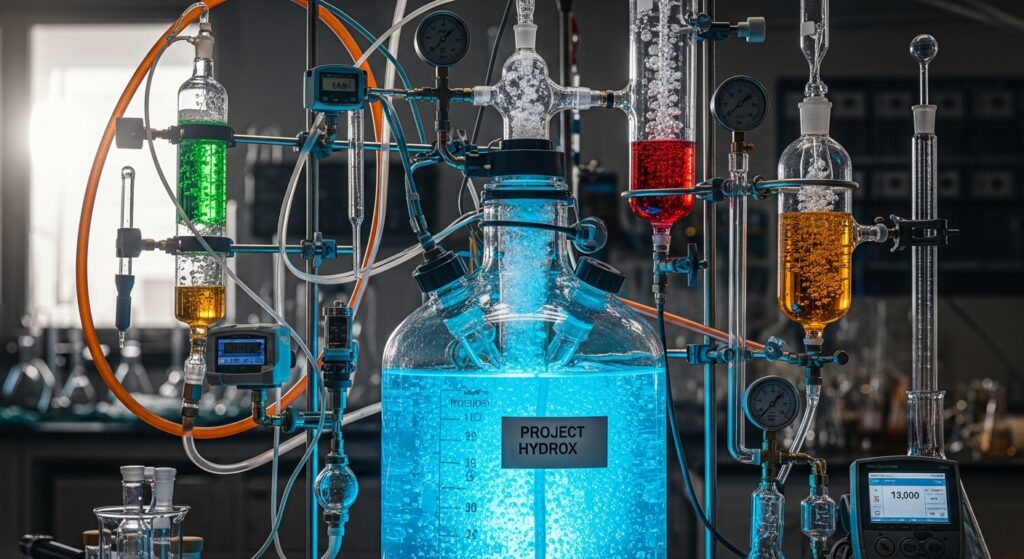
Let’s geek out a little. Water is made of hydrogen and oxygen, arranged in a way that makes each drop surprisingly complex. Each molecule, tiny as it is, contributes to the substance composition and overall density. A jug of liquid water isn’t just heavy it’s billions of water molecules interacting, vibrating, and subtly shifting.
Laboratory measurement of water sometimes considers temperature impact on water density, ensuring scientific water measurement is precise. Even small fluctuations matter in chemistry labs or when calculating weight of water for transport. It’s astonishing how a commonplace liquid carries so much depth in physical and chemical concept entities.
Everyday Examples That Make It Relatable
Here’s where the physics meets the human side:
- Filling your garden hose for evening watering? Those 5 gallons you carry are a microcosm of weight calculation formula in action.
- Buying bottled water in bulk? A 5-gallon jug’s pounds to kilograms conversion saves you surprises.
- Working on construction? Each bucket of liquid measurement conversion directly affects project stability.
- Camping? Water load calculation means life or exhaustion. Carrying 41.7 pounds (weight of 5 gallons) uphill is a small test of stamina.
Even in cultural traditions, water carries symbolic weight. In many households, the act of fetching water is seen as nurturing each jug of room temperature water is more than H2O, it’s care in motion.
Tips and Tricks: Making Water Weight Work for You

If you want to make the most out of knowing your water weight per gallon, here are some practical tips:
- Use a lightweight container if portability is key.
- Break bulk into multiple smaller jugs to avoid load capacity issues.
- Always consider temperature effect on density in precise scientific or culinary tasks.
- Keep conversions handy for volume-to-weight conversion between metric and imperial systems.
- For farming or construction, calculate weight of water for irrigation and water weight in construction separately to avoid errors.
These small strategies save aches, spills, and headaches literally.
Frequently Asked Questions
What is the weight of 5 gallons of water?
5 gallons of water weigh about 41.7 pounds or 18.9 kilograms at room temperature.
How many liters are in 5 gallons of water?
5 US gallons equal roughly 18.925 liters using the gallon to liter conversion.
Does temperature affect the weight of water?
Yes, temperature effect on density slightly changes water’s weight due to thermal expansion, but for everyday use, it’s minimal.
How do I convert gallons of water to kilograms?
Multiply the gallons by 3.785 to get liters, then multiply by 1 kg per liter for water at room temperature.
Why is water in ice form lighter per volume than liquid water?
Ice vs liquid water density difference makes ice less dense, so it floats and weighs less per same volume.
Read this Blog: https://nexovates.com/what-is-0-3125-as-a-fraction/
Conclusion: Appreciating the Power of Water
Next time you lift a 5 gallons of water jug, think about what you’re holding: nearly 19 kilograms of life-sustaining liquid water, billions of water molecules, perfectly balanced mass per unit volume, shaped by thermal expansion and state of matter quirks.
Water is mundane and magical all at once. It flows into cups, gardens, pools, tanks, and pipelines but also carries scientific, practical, and everyday significance with each gallon.
Water teaches patience, respect, and curiosity. Knowing the weight of water in pounds, understanding its density, and considering temperature effect on water density aren’t just exercises in math they’re small acts of mindfulness. So grab that jug, lift it carefully, and feel the invisible science that’s been shaping Planet Earth for billions of years.

