
There’s a peculiar kind of comfort in measuring things. Not life stuff (that’s chaos, honestly), but the small, tangible bits like pouring Milk into a cup or scooping Granulated sugar for a cake that you hope turns out okay-ish.
I remember once trying to bake a birthday cake for my niece, and I stood there, staring at a recipe that said “200 ml flour”… and I thought, wait, flour is… grams? milliliters? what are we even doing here.
That’s when the world of Milliliters to Grams Conversion Calculator tools quietly slipped into my life like an unsung hero. You don’t notice them until you really need them, and then suddenly, they’re everything. Whether you’re cooking, experimenting in a lab, or just trying not to ruin dinner (been there), understanding Milliliters to Grams conversion is kinda essential.
This article isn’t just numbers and formulas, nope. It’s a wandering journey through kitchen counters, science labs, and those tiny “aha!” moments where volume meets weight and everything makes just a bit more sense.
Milliliters to Grams Conversion Table (Common Ingredients)
| Ingredient | 50 ml | 100 ml | 200 ml | 250 ml |
|---|---|---|---|---|
| Water | 50 g | 100 g | 200 g | 250 g |
| Milk | 52 g | 103 g | 206 g | 258 g |
| Cooking oil | 46 g | 92 g | 184 g | 230 g |
| All-purpose flour | 25 g | 50 g | 100 g | 125 g |
| Granulated sugar | 42 g | 85 g | 170 g | 212 g |
Understanding the Basics of Milliliters to Grams Conversion Calculator
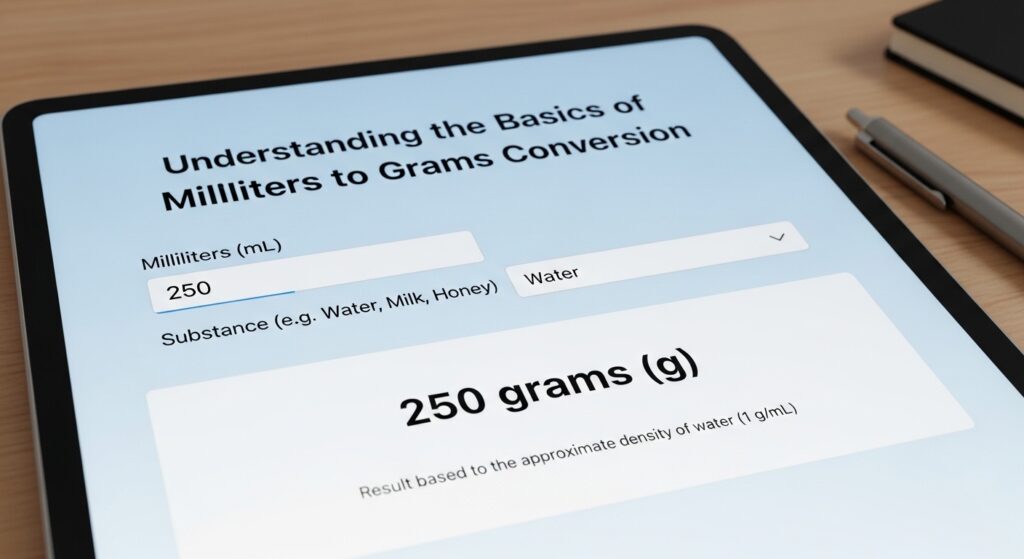
Let’s slow down a bit and talk basics, but not in that boring textbook tone that makes your brain want to nap.
A Milliliter (mL, ml, mℓ, cc) is a unit of Volume, while a Gram (g) measures Mass or Weight (well, technically mass, but people mix that up all the time, it’s fine-ish). So when you’re converting ml to grams, you’re basically trying to compare apples to… slightly heavier apples.
Here’s the kicker: you can’t convert directly without knowing one sneaky little thing Density (g/mL).
And here comes the famous line that honestly deserves more appreciation:
grams = milliliters × density
That’s the whole magic trick. This Conversion Formula ties together the Mass-Volume Relationship, making sense of how much something weighs based on how much space it takes.
A Unit Conversion Calculator simplifies all this, so you don’t have to do mental gymnastics while holding a measuring cup in one hand and a spoon in the other.
Why Density is the Real Star of Volume to Weight Conversion
Okay, so here’s where things get slightly nerdy but also kinda cool.
Not all things weigh the same per milliliter. Like, 100 ml of Water is about 100 grams easy, nice, predictable. But 100 ml of Cooking oil? That’s lighter. Flour? Even trickier, because it’s fluffy and full of air gaps.
Density is what connects Volume to Weight Conversion. It’s the personality of a substance, if you will. Some are dense and serious (looking at you, syrup), others are light and breezy (hello, flour clouds).
In science-y terms, density is:
Mass ÷ Volume
But in real life, it’s why your cake collapses if you guess wrong.
Experts from places like the National Institute of Standards & Technology (NIST) emphasize Measurement accuracy, especially in fields like Chemistry calculations and Stoichiometry, where even tiny errors can mess up entire Chemical reactions. Not dramatic at all, right?
Milliliters to Grams Conversion Calculator in Everyday Cooking
Let’s bring this back to the kitchen, where most of us actually care about this stuff.
Cooking is forgiving. Baking? Not so much. Baking is like a strict teacher who notices every little mistake.
Here’s how common ingredients behave:
- Water: 1 ml = 1 gram (the golden child of conversions)
- Milk: slightly heavier, about 1.03 g/ml
- Cooking oil: around 0.92 g/ml
- All-purpose flour: roughly 0.5–0.6 g/ml depending on how packed it is
- Granulated sugar: about 0.85 g/ml
So yeah, “100 ml flour” is not 100 grams. It’s more like… a guessing game unless you know the density.
That’s why a ml to g calculator is honestly a kitchen lifesaver. Especially when recipes come from different countries using different Metric System standards or even switching to Ounces just to confuse you.
I once saw someone say, “I don’t measure, I just feel it.” That works for spices, maybe. Not for cake.
Milliliters to Grams Conversion Calculator in Science and Labs
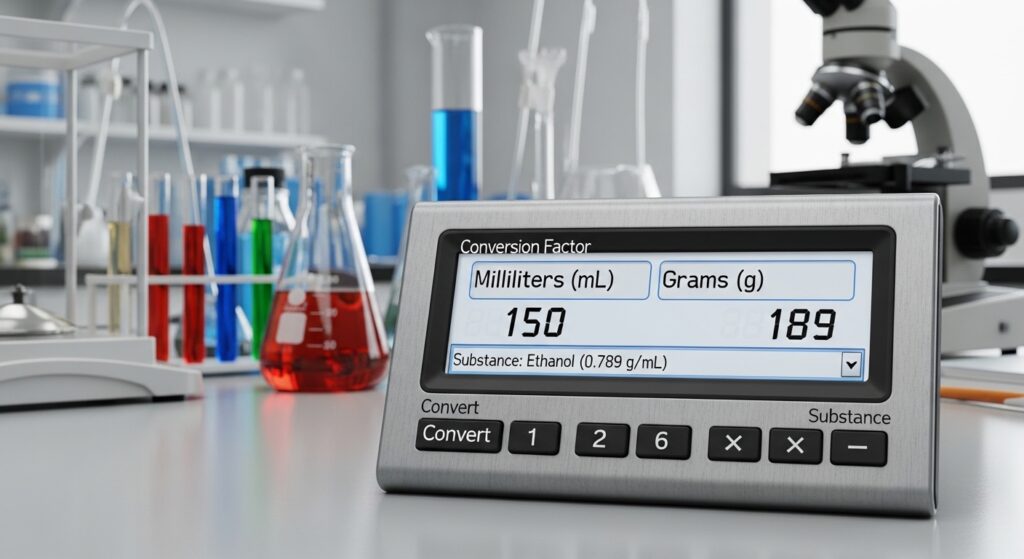
Now imagine you’re not baking a cake but mixing chemicals. Suddenly, things get serious real quick.
In Laboratory measurements, precision isn’t optional it’s everything. Scientists rely on accurate Volume-to-mass conversion to ensure reactions behave exactly as expected. A slight miscalculation in Aqueous solutions or Powdered vs liquid substances can lead to wildly different results.
Educational platforms like CK-12 Foundation and LibreTexts Chemistry explain how Density dependency plays a crucial role in these calculations. And honestly, once you get it, it feels oddly satisfying.
Even gravity sneaks into the conversation. On Earth, Mass vs weight distinction doesn’t matter much for everyday conversions, but technically, Weight changes with gravity (hello Moon experiments), while Mass stays constant.
It’s a bit mind-bending, but also kinda fascinating.
A Gentle Guide: How to Convert Milliliters to Grams Without Losing Your Mind
Alright, let’s keep this simple-ish.
If you don’t have a Digital scale, here’s how you can still manage:
- Find the density of the ingredient (quick search works)
- Multiply by the volume in ml
- Try not to overthink it too much
Example:
100 ml of oil × 0.92 = 92 grams
That’s it. That’s the whole journey.
But honestly, using a volume to weight calculator saves time and reduces mistakes. And in baking or science, mistakes have consequences (usually edible, sometimes explosive… kidding, mostly).
Grams to Milliliters: The Reverse Dance
Sometimes, life flips things around and you need Grams to Milliliters instead.
In that case, you rearrange the formula:
milliliters = grams ÷ density
Same logic, just walking backwards.
This comes in handy when recipes give weight but you only have measuring cups, which happens more often than you’d think, especially in home kitchens where tools are… a bit random.
Common Conversion Mistakes (We’ve All Been There)
Let’s be real, everyone messes this up at some point.
- Assuming all liquids behave like Water
- Scooping flour differently each time (packed vs loose)
- Ignoring density completely (bold move, risky tho)
- Mixing up SI Units like Liter, Kilogram, and Cubic centimeter (cm³)
Joe Sexton and Ethan Dederick, PhD, both known for explaining measurement systems in a practical way, often stress that understanding why conversions work is just as important as memorizing them.
And yeah, that makes sense. Otherwise, you’re just guessing with confidence.
Cultural Moments: Measuring Love in Different Kitchens
Here’s a small detour, because this stuff isn’t just science it’s culture too.
In South Asian kitchens, including places like Multan, people often measure ingredients by instinct. “Ek cup,” “aadha chamach,” or just “bas thora sa.” There’s an art to it, honestly.
A grandmother once said, “We don’t measure with spoons, we measure with experience.” And that’s beautiful… but also slightly terrifying if you’re new to cooking.
Meanwhile, Western recipes lean heavily on precise measurements, emphasizing Recipe standardization and consistency.
Both approaches have their charm. One is poetry, the other is math. Ideally, you learn both.
Practical Tips for Better Conversion Accuracy
Let’s make life easier, shall we.
- Use a Digital scale whenever possible
- Stick to one measurement system per recipe
- Learn densities of common ingredients
- Double-check conversions when baking
- Use a reliable Unit Conversion Calculator
These tiny habits improve Measurement precision, which leads to better results whether it’s a cake or a chemistry experiment.
How to Write a Custom Message (Yes, Even About Measurements)
You might be thinking… what does this have to do with writing messages?
Well, everything, in a weird way.
Precision matters in communication too. Just like you wouldn’t randomly guess grams from milliliters, you shouldn’t throw generic words at meaningful moments.
If you’re sharing a recipe, teaching someone, or even writing a note, make it personal:
- Add a memory (“this cake always reminds me of…”)
- Include a tip (“don’t overmix, trust me on this one”)
- Keep it human, a little imperfect even
Because honestly, perfection is overrated. Slight messiness feels real.
Creative Ways to Share Your Conversions (Yes, Really)

Okay this might sound odd, but hear me out.
- Write conversions on recipe cards and pass them down
- Share your favorite ml to grams conversion hacks with friends
- Create a small kitchen chart for quick reference
- Turn it into a learning moment with kids
Little things like this turn boring numbers into shared experiences.
Frequently Asked Questions
ml to grams
Milliliters (ml) can be converted to grams (g) using the density of the substance, since volume and mass are different units.
milliliters to grams
To convert milliliters to grams, multiply the volume by the density of the ingredient in g/mL.
100 ml to grams
100 ml equals 100 grams only for water; for other substances, the weight depends on their density.
ml to g
The conversion from ml to g requires a density value, using the formula: grams = ml × density.
ml to gram
Milliliters can be converted to grams by applying the density of the material, as different substances have different weights for the same volume.
Read this Blog: https://www.inchcalculator.com/convert/milliliter-to-gram/
A Warm, Slightly Flour-Dusted Conclusion
At the end of it all, a Milliliters to Grams Conversion Calculator isn’t just a tool. It’s a bridge between guessing and knowing, between chaos and control, between “eh this might work” and “yes, this will work.”
Whether you’re baking a cake, mixing chemicals, or just trying to follow a recipe without panicking halfway through, understanding Volume to Weight Conversion gives you quiet confidence.
And maybe that’s what matters most not perfect measurements, but the feeling that you kinda, sorta know what you’re doing.
If you’ve ever struggled with converting ml to grams, or if you’ve got your own little kitchen stories, share them. There’s something oddly comforting in knowing we’re all just figuring it out, one measurement at a time.

